
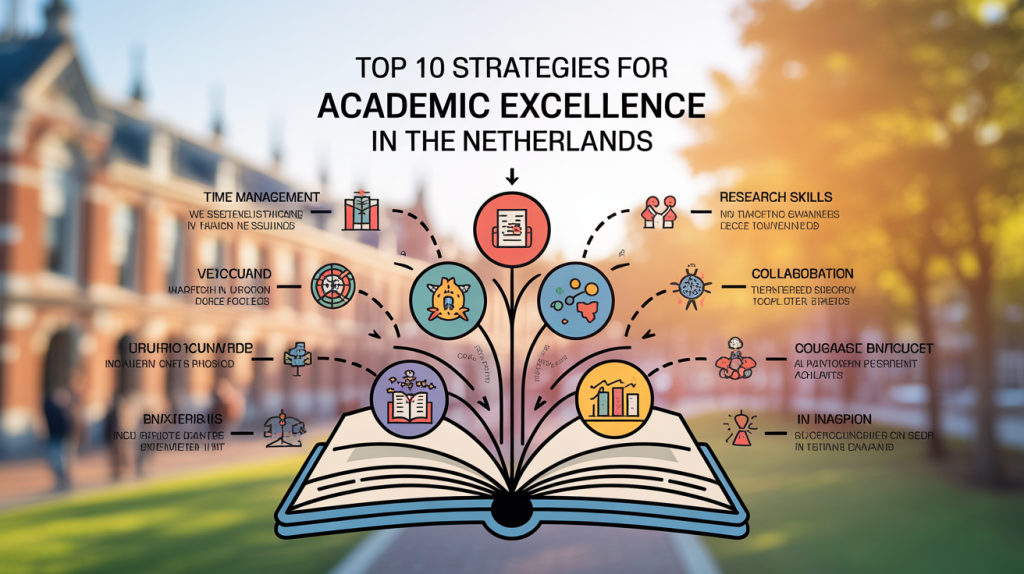
Top 10 Strategies for Academic Excellence in the Netherlands’s Competitive Environment
- Embrace Active Participation and Autonomy
- Master Problem-Based Learning (PBL)
- Prioritize Time Management
- Engage in Collaborative Group Work
- Participate in Seminars and Practical Assignments
- Seek Support from Professors and Tutors
- Adapt to Diverse Assessment Formats
- Build a Network with International and Local Peers
- Develop Multidisciplinary Knowledge
- Make Use of Campus Resources and Support Services
Embrace Active Participation and Autonomy
The Netherlands is globally recognized for its high-quality education system and innovative teaching methods that foster academic excellence. International students pursuing their studies here encounter a competitive yet supportive environment designed to develop critical thinking, independence, and practical skills.
At Dutch universities, autonomy is encouraged, with a strong emphasis on students taking the initiative in their education. Active participation in lectures, seminars, and class discussions is essential for success.
Key actions for students and educators:
- Encourage independent research and preparation before classes.
- Facilitate interactive sessions that involve debates and critical analysis.
- Promote a classroom culture where students feel comfortable expressing ideas.
Master Problem-Based Learning (PBL)
Problem-Based Learning (PBL) is a widely used pedagogical method in Dutch higher education, placing students in collaborative groups to solve real-world problems. This approach develops analytical thinking and promotes teamwork.
Benefits of PBL include:
- Enhanced problem-solving and critical thinking skills.
- Improved ability to work in diverse groups.
- Development of self-directed learning habits.
Prioritize Time Management
Balancing lectures, group assignments, and independent study requires effective time management skills in the intensive academic programs of the Netherlands.
Strategies for effective time management:
- Develop a detailed weekly study schedule.
- Break down assignments and prepare well in advance.
- Allocate time for rest and social activities to maintain wellbeing.
Engage in Collaborative Group Work
Group assignments are integral to the Dutch academic model and reflect professional work environments. Active engagement and leadership in group projects contribute to better outcomes and develop essential interpersonal skills.
Critical components of successful group work:
- Clear communication and role allocation.
- Respect for diverse perspectives.
- Commitment to collective goals.
Participate in Seminars and Practical Assignments
Seminars and practical assignments provide deeper engagement with course materials. They require students to apply theory, analyze issues, and improve communication skills.
Tips for success in seminars and practical work:
- Prepare thoroughly by reviewing relevant literature.
- Actively participate and present ideas confidently.
- Seek feedback for continuous improvement.
Seek Support from Professors and Tutors
Dutch professors and tutors are known for their approachability and willingness to assist students. Proactively seeking clarification or feedback is encouraged.
How to leverage academic support efficiently:
- Attend office hours or schedule consultations.
- Ask specific questions about course content or assignments.
- Utilize faculty expertise for academic and career guidance.
Adapt to Diverse Assessment Formats
Assessment in Dutch universities encompasses essays, presentations, group projects, and practical assignments. Familiarity with various formats is crucial for success.
Preparing for diverse assessments involves:
- Understanding criteria and expectations for each format.
- Developing strong writing and presentation skills.
- Practicing self-assessment and peer reviews.
Build a Network with International and Local Peers
The Netherlands hosts a multicultural student population, making networking an invaluable tool for academic growth.
Networking advantages include:
- Access to diverse perspectives and knowledge.
- Collaborative opportunities beyond the classroom.
- Support systems that ease adaptation to a new country.
Develop Multidisciplinary Knowledge
Many Dutch institutions offer flexible programs that allow students to explore subjects beyond their primary field, encouraging versatility and innovation.
Encouraging multidisciplinary learning:
- Enroll in elective courses outside the main study program.
- Engage in cross-departmental projects and research.
- Foster curiosity and continuous learning.
Make Use of Campus Resources and Support Services
Dutch universities provide extensive resources including academic advising, counseling, and career services. Utilizing these aids maximizes academic performance.
Examples of valuable support structures:
- Writing centers and libraries for research assistance.
- Mental health services to manage stress.
- Career guidance and internship placement offices.
Take the Next Step with Study in Netherlands
Achieving academic excellence in the Netherlands’s competitive environment is a journey that requires proactive engagement with its unique teaching methods and support systems.