
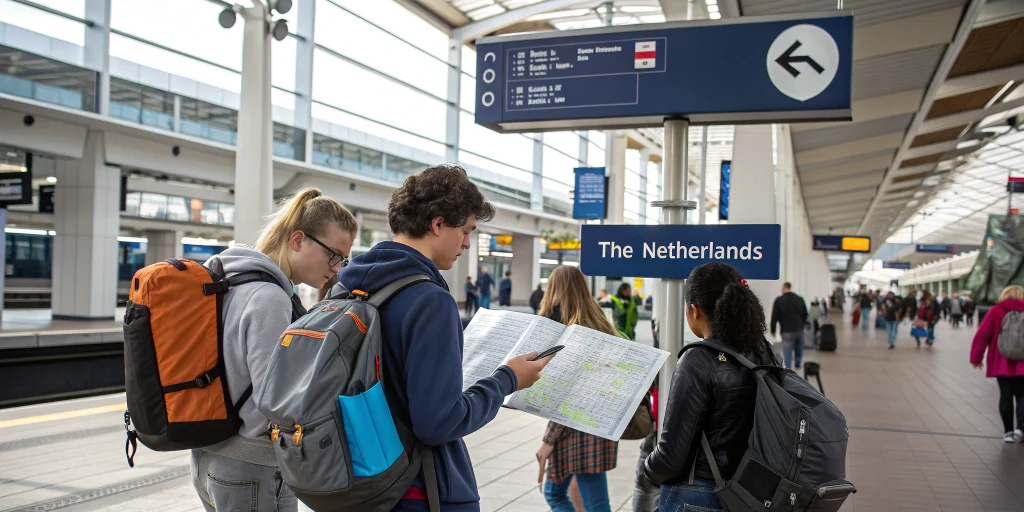
Tips for International Students: Navigating Netherlands’s Public Transport
Understanding the Main Modes of Transport in the Netherlands
The Dutch public transport network stands out for its diversity and coverage, connecting major cities, towns, and rural areas through a coordinated system composed of:
- Trains: The backbone of intercity travel, trains provide fast, frequent connections between larger cities and regional towns.
- Buses: Especially important in smaller cities and rural areas, buses cover routes not accessible by train.
- Trams: A common urban transport mode found predominantly in cities like Amsterdam, Rotterdam, and The Hague. Trams offer scenic and efficient travel within city limits.
- Metros: Primarily used for faster inner-city commutes in major urban areas.
- Ferries: Used mainly in coastal or canal areas to connect parts of cities separated by water.
- Public Bikes: With one of the world’s best cycling infrastructures, public bikes complement other transport modes for last-mile connectivity.
In cities such as Amsterdam, Rotterdam, and The Hague, students will find all these transport options integrated seamlessly, while in smaller cities buses typically serve as the primary form of public transport.
Planning Your Journey: Efficient and User-Friendly
One of the strengths of the Netherlands’ transport system is how easy it is to plan and execute journeys:
- Operating Hours: Most transport services run from 6:00 AM to 1:00 AM, with night buses available in larger cities for late-night travel.
- Digital Tools: Real-time journey planning apps and websites allow students to check timetables, routes, and disruptions efficiently.
- Integrated Scheduling: Timetables are designed for smooth transfers, minimizing wait times between different modes of transport.
Students are encouraged to familiarize themselves with public transport apps and station displays early on to proactively manage their travel and avoid delays.
Using the OV-chipkaart: Your Key to Seamless Travel
The OV-chipkaart is a contactless smart card that serves as the standard ticket for all public transport across the Netherlands:
- Flexibility: Available as personal (registered) or anonymous cards, the OV-chipkaart can be used on all modes of public transport.
- Usage: Riders load credit onto the card and must check in and out every time they board and disembark.
- Accessibility: The card is widely sold at train stations, supermarkets, and convenience stores.
For international students, registering a personal OV-chipkaart can enhance convenience by enabling online top-ups and recovery options in case of loss.
Combining Cycling with Public Transport: The Dutch Way
The Netherlands is famously bike-friendly, and many students combine cycling with public transport for the most efficient travel experience:
- You can bring your bicycle on trains and metros outside peak hours by purchasing a bicycle day ticket.
- Bicycles should be stored in designated areas on public transport to keep travel safe and organized.
- Many universities provide secure bike parking, supporting this eco-friendly, cost-effective transport combination.
Adopting a mixed transport approach can save time during commutes and also enrich your local experience by exploring cities on two wheels.
Practical Tips for a Smooth Transport Experience
To make the most of the Dutch public transport system, international students should keep these key points in mind:
- Always check in and out: Forgetting to do so will result in fines.
- Look for discounts: Student discounts or youth traveler deals are often available.
- Avoid peak hours if possible: Morning and evening rush hours can be crowded.
- Plan for distances: If your university campus or accommodation is far from city centers, trains and buses will be your main daily travel options.
- Use reliable information sources: Keep apps updated and check information boards regularly.
Summary of Key Features of Dutch Public Transport
| Feature | Details |
|---|---|
| Main Modes | Train, bus, tram, metro, ferry, public bike |
| Ticketing | OV-chipkaart (personal or anonymous) |
| Operating Hours | 6:00 AM – 1:00 AM (night service in large cities) |
| Combining with Cycling | Bikes allowed on train/metro with ticket (off-peak) |
| Journey Planning | Apps/displays at stops; real-time schedules |
| Discounts | Available for students and young travelers |
How Study in Netherlands Supports Your Transport Needs
At Study in Netherlands, we understand how crucial it is for international students to feel confident and supported from day one. Our team provides comprehensive advice on navigating public transport as part of our broader student assistance services.
We partner with universities, recruitment agencies, and education professionals to ensure seamless transitions for students, including travel and mobility solutions.
Conclusion and Call to Action
Navigating the Netherlands’s public transport system is straightforward once you understand the basics and use the right tools and tips. International students can enjoy a convenient, affordable, and environmentally friendly way to explore their new home.
Take the Next Step with Study in Netherlands
Ready to enhance your international recruitment strategy or need guidance on student mobility solutions? Contact Study in Netherlands today to explore partnership opportunities and expert support tailored to your institution’s needs.